

At first light, before the bush has fully stirred, there is a moment every guide knows well: that quiet threshold between night and day when the landscape seems to pause and take a breath. For those attuned to bird song, this is a time seldom filled by silence, but rather one layered in symphony. The liquid bubbling of a White-browed Robin-chat, the incessant chatter of Yellow-bellied Greenbuls, the mechanic whirling of a Lesser Masked Weaver colony, and a final rendition of “good lord deliver us” from the nocturnal Fiery-necked Nightjar. To the untrained ear, it is simply ambience, setting the scene for another day in Africa. To a birder, it is information in its most pure form: the bush is alive, the news is immediate, and what it’s sharing is deeply informative.
BIRDING: THE ART OF NOTICING
Within South Africa’s ecotourism industry, we are fortunate in that birding is viewed as a specialised skill, and more recently, a niche specialist industry in itself. However, despite the high degree of specialisation, there remain skills associated with birding that are far more foundational. In fact, birding is one of the most powerful ways for guides to sharpen perception, deepen ecological understanding, and elevate the quality of guided experiences that we provide to our guests.
At its very core, birding is, quite simply put, the art of noticing. Not merely seeing, but truly observing nature on different levels with the use of several different senses. A flicker of movement in a thornveld canopy, the silhouette of wings riding a thermal, the abrupt tonal shift from contact call to alarm call in a flock of starlings – these are all subtle cues that demand our attention.
Over time, this discipline transforms how we as guides are able to engage with the environment around us. Landscapes are no longer static backdrops; they become dynamic systems layered with meaning. A patch of broad-leaved woodland evolves into a mosaic of niches – potential habitat for barbets, hornbills, shrikes, or even, a well-camouflaged owl. A wetland becomes a living calendar, its fluctuation in avian diversity marking the passage of seasons and the arrival of migratory species from their Palearctic breeding grounds some tens of thousands of kilometers away.
This heightened awareness translates directly into more effective and compelling guiding. There are many guests who will seek a lengthy and impressive checklist of sightings over the duration of time with you, but whether they elude to it or not, they will also seek insight; they too, will want to notice. A guide who consistently notices birds demonstrates a deeper intimacy with their surroundings, an attentiveness that builds trust and curiosity among those in their care. When you can explain how a Fork-tailed Drongo uses the skill of mimicry to outwit other species in its quest for food, or interpret the different alarm calls of Grey Go-away Birds and Crested Francolins to help ascertain the presence of a leopardess moving through dense woodland, you move beyond basic sound identification and into the realm of interpretation. You begin to reveal nature’s secrets: the invisible threads that connect species, behaviours, and habitats. This is where guiding becomes storytelling, which is grounded in deep ecological understanding.
PATIENCE AND PRESENCE
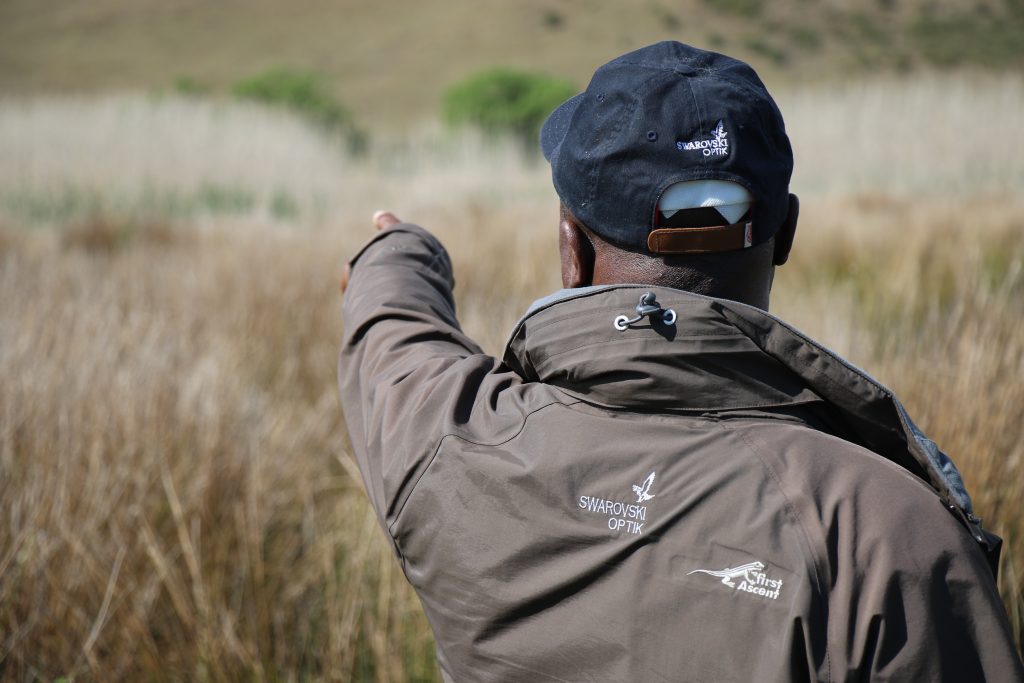
Birding also cultivates patience and presence, qualities that are indispensable in the field. Unlike some larger mammals, birds seldom present themselves on cue. They require stillness, anticipation, planning, and a willingness to slow down. In an industry often driven by tight schedules and high expectations, birding is an art form that gently pushes against it all, and resists the urge to rush. It teaches us, as guides, to trust the process of observation rather than the pursuit of instant gratification. Interestingly, this shift often influences our guests as well. When a guide embodies patience, guests tend to settle into the experience, becoming more receptive, engaged, and open to interpretation of nature’s smaller treasures.
COGNITIVE BENEFITS
There is also a profound cognitive benefit derived from birding that is increasingly supported by scientific research. Activities that involve focused attention, pattern recognition, and sensory integration – such as identifying birds by sight and sound – are known to stimulate and strengthen our brains’ neural pathways. Birding draws simultaneously on memory (recalling hundreds of field marks and calls, from hundreds and sometimes even thousands of species), auditory processing (distinguishing subtle variations in bird song), and spatial awareness (tracking movement through complex habitats, or remaining permanently aware of what the bush is sharing with us through the presence of birds). Over time, this multi-layered engagement has shown enhancement in concentration, improvement in recall ability, and the sharpening of spit-second decision-making skills.
For guides, these cognitive benefits are not abstract – they manifest themselves in daily practice. A birder’s brain becomes more agile, more responsive to nuance, more aware. You begin to anticipate behaviour, to notice the most subtle of anomalies, to connect seemingly unrelated observations into coherent patterns, and to become connected to nature on a much deeper level. This mental acuity extends far beyond birds: it also enriches one’s ability to interpret tracks, predict the movement of other animals, interpret weather patterns, and navigate the ever-changing dynamics of the industry’s working environment.
MENTAL HEALTH BENEFITS
Linked to this, and of equal importance, are the mental health benefits associated with birding. Guiding, while immensely rewarding, can also be physically and emotionally demanding. Long hours, variable conditions, and the pressure to consistently deliver nothing short of exceptional experiences can lead to both physical and emotional fatigue, stress, and anxiety. Birding offers a form of active mindfulness and a way to anchor one’s attention in the present moment through a process known as “deliberate observation”.
Listening for bird calls, actively scanning a bird-party comprised of varying species, or following a feathered figure as it gains altitude in what seems to be a never-ending soar, all create a state of calm alertness. Psychologists often refer to this as a “flow” state, where the mind is fully engaged yet unburdened by the emotionally draining distractions of our day-to-day lives.
Studies have shown that such interactions with nature can lower cortisol levels, reduce symptoms of anxiety, and enhance overall emotional well-being. Even brief moments of bird-focused attention, such as a pause after drive, or a quiet break once having started the campfire on a walking trail, can have a beneficial restorative effect on one’s mental wellbeing.
There is also an intangible quality to birds that, when combines with our innate curiosity as a human race, resonates deeply with many who take the time to observe them. Perhaps it is their mobility; their ability to traverse vast distances with apparent ease, reach incomprehensible heights, or their complete disregard for borders and passport control. Whatever the reason, birds often evoke a sense of wonder and shear awe from deep within us that is both grounding and uplifting. For us as guides, this can become a personal anchor, and a reminder of why we chose this profession in the first place; to experience raw moments of appreciation such as these.
FROM BEGGINER TO BIRDER
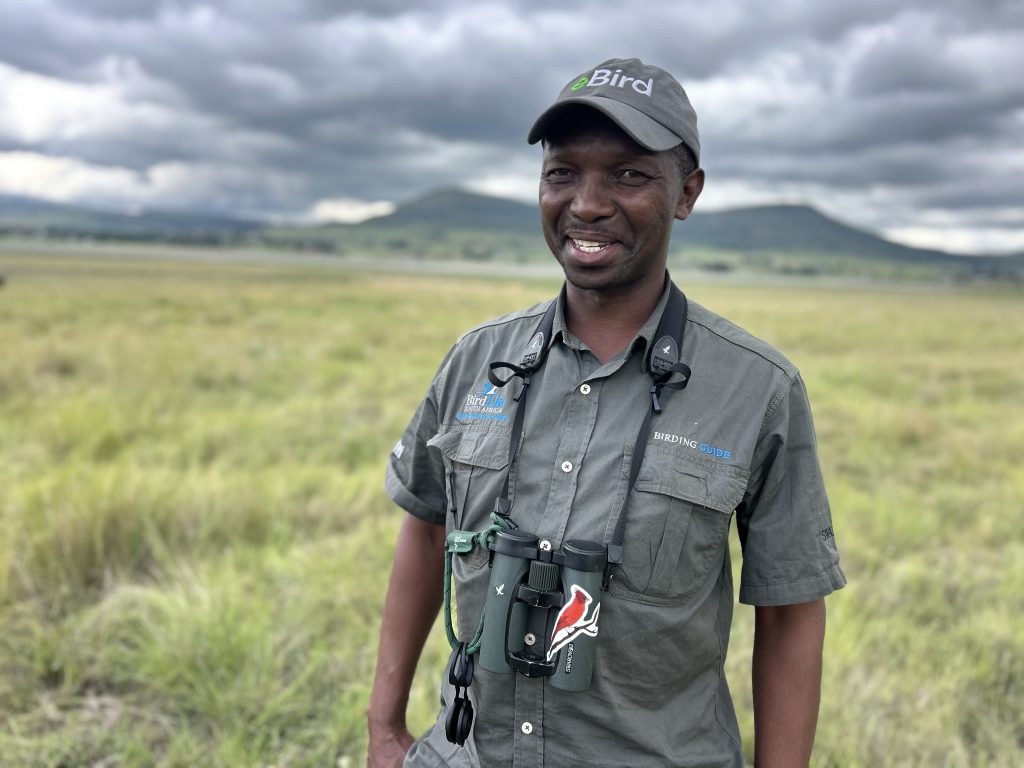
From a practical perspective, birding significantly broadens a guide’s interpretive toolkit. South Africa’s avifauna is extraordinarily diverse, offering a wealth of stories that can captivate a wide range of guests. Species with epic migrations that span continents, intricate nesting strategies involving cooperative breeding, polygamy, and even deceit, and remarkable adaptations to some of the world’s harshest environments – these narratives add depth and texture to any guiding experience. Not everyone may begin their birding journey as somebody who was a dedicated birder, or even somebody who was remotely interest in birds, but almost all can be drawn into the wonders of birds through the intrigue of a well-told story.
Importantly, embracing birding does not require immediate expertise. It begins with curiosity, a willingness to engage, and taking moments to notice. Learning to identify a handful of common species, becoming familiar with their calls, and gradually building your confidence in the field is a natural and rewarding progression. Modern tools at our disposal, including an extensive selection of field guides, mobile apps, online sound libraries, and digital resources, can all help accelerate your learning. But remember, that these are always most effective when paired with consistent, mindful observation and time spent refining your skills, practically, in the field.
There is also a broader conservation element to birding that aligns closely with the principles of responsible and sustainable guiding. Birds are often sensitive indicators of an ecosystem’s health. Changes in their distribution, abundance, or behaviour can signal shifts in environmental conditions, many times, before these changes even become apparent in other taxa. Guides who are attentive to birdlife are therefore far better positioned to notice and interpret these subtle signals, and can contribute to a deeper understanding of the landscapes they work within.
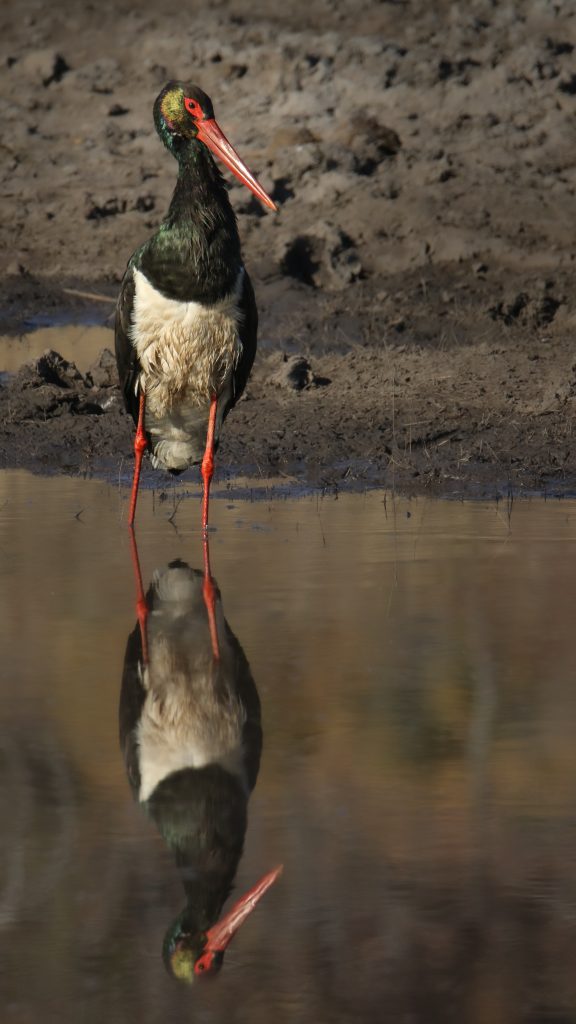
Ultimately, birding enriches guiding because it deepens connection – connection to a place, to nature, to the process, and to one’s self. It encourages a way of seeing that is attentive, informed, and deeply aware. In a profession built on sharing with others all the wonders of the natural world, this depth of engagement is invaluable.
So, the next time the dawn chorus begins, take the opportunity to pause for a moment. Resist the urge to move too quickly into the day’s agenda, or the pre-conditioned reply over the radio requesting a standby spot at another ingwe ‘loc’. Listen closely. In those layered calls lies not just the promise of a new day, but an invitation. An invitation to notice more, to understand more, and to guide with your guests with far greater depth, authenticity, and purpose.
John Kinghorn
Images supplied : Andrew de Blocq