

Author: Steve Woodhall
As insects, butterflies and moths occupy a low position in the food chain, positioned just above the plants that serve as their primary food source. Many animals prey upon them. Over hundreds of millions of years, these species have developed various adaptations to reduce the likelihood of predation by sight hunters.
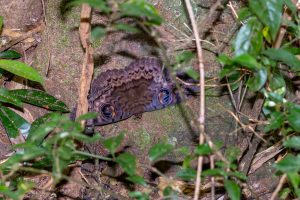
Some strategies include developing toxicity (and displaying warning colouration), mimicking toxic species, or using camouflage to avoid detection. Predators such as birds and mammals often hunt visually and may overlook individuals that resemble dead leaves, twigs, or rocks. The wings of adult butterflies and moths facilitate these forms of concealment. It’s not just the colours and patterns on the wings that can hide them. There are all sorts of strategies like patterns that break up their outline. Many moths, in particular, have resting postures that add to the camouflage effect.
Not only do adults employ these tactics; caterpillars and chrysalides are also targeted by predators, especially birds that feed them to their offspring. While they lack wings, their coloration and shapes often allow them to blend into their surroundings.
This adaptive strategy is known as camouflage, and it is common among butterflies and moths. Here we’ll show you a few examples from South Africa.
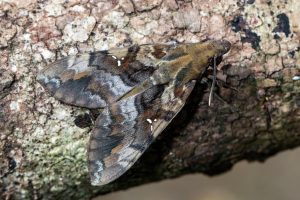
Bred by Lucia Phillips
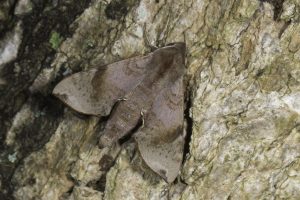
Because many moths are night-flying (nocturnal) they need to take refuge when at rest during the day. Having cryptically marked forewings and resting with them facing outwards allows many moths to ‘hide in plain sight‘. The image many people have in mind when they hear the word ‘camouflage’ is of a soldier wearing ‘camo kit’. The neutral earth and leat tones combine on this Accented Hawkmoth Nephele accentifera (a member of the family Sphingidae in the superfamily Bombycoidea) to break up its outline and disappear into the background. Its caterpillar uses a different strategy. Its tail horn (to the right) is the same colour as the leaf petioles on the Ficus (fig) host plant and it has pale lateral stripes that mimic the leaf’s veins. Its body is countershaded, being paler on the dorsal (back) surface and darker ventrally (on the belly). This allows it to blend into the foliage and avoid being seen.

There is great variety among the Hawkmoths. Verdant Hawkmoth Euchloron megaera appears to be extremely conspicuous when placed on bark but among green leaves it vanishes, as shown in the slide show in the header. Grey Temnora Temnora murina is plainer in appearance and relies on its dull colour to protect it when at rest.
Superfamily Noctuoidea comprises two large families, Noctuidae and Erebidae. The latter includes many small species that use camouflage. The Decorous Widebar, Metachrostis decora, is difficult to see when resting on mossy tree bark with lichen patches. The Eyed Snout, Hypena erastrialis, is found in woodland areas among dead bark and leaves; its straight median line resembles a leaf midrib.
Walker’s Owl Erebus walkeri is the largest member of the Erebidae with a wingspan of up to 65mm. It spends most of its time hidden in shady places or flying at night but if it is caught out in the open (as this one was) its wavy patterning hides it well against tree bark. Narrow Jigsaw Dysgonia properans is another small species whose geometric forewing patterns help to break up its outline when resting amongst dead leaves.
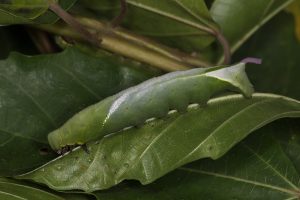
The family Noctuidae is difficult for the uninitiated to separate from Erebidae because the critical difference lies in the pattern of wing veins in the forewings. This is not easily visible in naturally posed specimens. It has many well-camouflaged small species like White Quaker Mentaxya albifrons which like the Narrow Jigsaw has patterns that break up its outline. White-vein Meliana, Meliana tenebra, is a grassland species whose streaked forewings hide it well when resting among grasses.
The Geometridae family of moths within the superfamily Geometroidea is renowned for its advanced camouflage abilities. Adult moths in this family typically rest with their wings open, exhibiting appearances that mimic leaves (both living and dead), bark, lichen, bird droppings, or twigs. The term ‘Geometridae’, meaning ‘earth measurers’, refers to the locomotion method of their caterpillars. These larvae possess three pairs of articulated ‘true’ legs on the thorax near the head, with only two pairs of ‘prolegs’ at the posterior end of the abdomen. When stationary, they often adopt a rigid posture on their prolegs, closely resembling dead twigs, leaf petioles, or dried leaves. During movement, they extend their bodies forward to grip the substrate with their true legs, then release the prolegs and bring the rear of their bodies towards the head, forming a loop. This sequential motion—alternately grasping and releasing with each set of legs—creates a distinctive looping gait, giving rise to the impression of ‘measuring’ the surface beneath them, which is reflected in their name. The Common Bark moth, Ascotis reciprocaria, is a classic example of this, as shown in the video of its caterpillar walking.
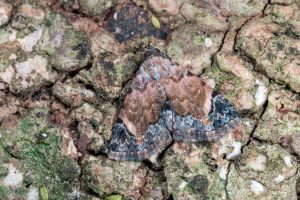
Two notable examples highlighting the diversity within the Geometridae family are the Storm Wave, Chrysocraspeda leighata, and Neptune’s Vestal, Traminda neptunaria. While the adult Storm Wave exhibits striking coloration when displayed on foliage—as demonstrated by this reared specimen—it becomes nearly imperceptible against tree bark. In contrast, Neptune’s Vestal is commonly recognized as the quintessential ‘little green moth on a wall,‘ often serving as an introduction to these moths for many individuals. Its presence among green leaves renders it difficult to detect.
The caterpillars of these species further illustrate distinct camouflage strategies employed by Geometrids. The Storm Wave caterpillar, when adopting a rigid posture, closely resembles the midribs of its host plant, the Hiccup-nut Combretum bracteosum, making it virtually indistinguishable from its surroundings. Similarly, the larva of Neptune’s Vestal mimics the appearance of a dried leaf from its host, a Thorn-tree Vachellia species, enhancing its concealment.
The Confused Omphax Omphax bacoti is a member of the Geometridae family that does not rest with its wings fully open. This species is diurnal, and when disturbed, it exhibits erratic flight patterns within its grassland habitat before rapidly descending and concealing itself. Upon closer examination, individuals can be found hiding beneath green leaves, where they rest with their wings folded downward. The Scribbled Duster Pingasa distensaria, another notable Geometridae species, is relatively large and at rest closely resembles a patch of lichen. This camouflage is effective on tree bark and equally so in environments where lichen is present, such as rocks or walls.
The Hesperiidae family, commonly referred to as Skipper butterflies, includes numerous species that exhibit cryptic or subdued colouration. Many species within this family rest with their wings open, similar to moths, displaying upper wing surfaces adapted for camouflage. The Forest Elfin, Sarangesa motozi, exemplifies this trait. These butterflies are challenging to observe in flight due to their speed, agility, and preference for shaded habitats with dappled light. When settled among leaf litter on the forest floor, they become virtually indistinguishable from their surroundings.
A distinct subgroup of Skippers, known as the Sandmen, is characterized by their diminutive size and exceptionally rapid, low-altitude flight. Their erratic movement through the air aptly reflects their common name, as they seem to ‘skip’ and are difficult to track visually. Although not overtly camouflaged when at rest with wings open, their muted coloration and small stature contribute to their inconspicuousness. For instance, the Dwarf Sandman, Ernsta nanus, possesses a disruptively patterned underside that effectively breaks up its outline when resting with closed wings.
Caterpillars of the Hesperiidae are infrequently encountered since they reside within shelters constructed from leaves or debris bound together with silk threads. Both the Orange Elfin caterpillar, Sarangesa phidyle, and the Forest Sandman, Ernsta dromus, were temporarily removed from their shelters for photographic documentation. A distinctive morphological characteristic of all Skipper larvae is the pronounced constriction resembling a ‘neck’ between the thoracic segments and the head. While these species possess green larvae that blend seamlessly into their environment should they venture outside their shelters, others display more vivid coloration, potentially conferring protection through mimicry of unpalatable butterfly species.